
In this article, you will learn
- How do caps with a dispenser and an insert work?
- What is the difference between a dropper insert, a flow restrictor, and a sealing insert?
- How do you select a closure for a liquid medication, drops, or a solution?
Cap with a dispenser – how does it work in medication packaging?
A dispensing cap combines the functions of a closure and an applicator. Depending on the design, it can control the flow of drops, limit the volume of liquid poured, or work in conjunction with a pipette, dropper, or other dispensing system.
Such solutions are primarily used for liquid preparations. This applies to drops, tinctures, solutions, liquid supplements, and compounded products. Consistency of dosing is key; the user should receive the exact amount of the preparation intended by the manufacturer or pharmacist.
Dropper in the cap
A dropper is designed to dispense liquid in small, controlled portions. Pharmaceutical caps utilize various types of droppers, including edge-dispensing, vertical, and multi-channel versions. They differ in their liquid flow mechanism and orifice size.
In practice, R1–R4 edge-type droppers, as well as KWK or MFF solutions, are selected based on the product's viscosity and the desired drop size. Low-viscosity liquids require a different flow control mechanism than more viscous products.
It is not always a matter of drop-by-drop dosing. Sometimes, simply slowing down the pouring process is enough to reduce the risk of spilling the product.
A flow restrictor reduces the amount of liquid dispensed from the bottle. Such components are used with syrups, solutions, and liquid preparations that the user subsequently measures out using a dosing cup, measuring device, or spoon. The range of caps includes, among others, 3.5 mm and 6.0 mm restrictors, as well as W1–W4 variants for larger diameters.
Sealing insert – small component, big role
The sealing insert is located inside the cap. Its function is to secure the interface between the bottle neck and the closure. This is important for liquid products that are prone to leakage, evaporation, or contact with air.
The choice of liner depends on the type of product, the bottle material, and storage requirements. One type of liner is suitable for syrups, another for alcohol-based solutions, and yet another for products requiring a stronger barrier.
Polyethylene liners are used in many standard pharmaceutical closures. They perform well with liquid preparations, where a tight seal and a proper fit to the bottle threads are essential. They are a common choice for caps used on pharmacy bottles, syrups, and compounded products.
Aluminum liners are used where a stronger barrier is required. Induction liners can provide tamper-evidence and limit contact with external factors. Teflon liners are selected for products that require high material resistance.
Cap diameter and dispensing method
Cap diameter and dispensing method
The cap diameter determines which bottle and dispenser it is compatible with. Caps with diameters of 18 mm, 22 mm, and 28 mm are commonly found in pharmaceutical packaging.
18 mm caps for dropper and small bottles
18 mm caps are typically used for small bottles. This size is common for drops, tinctures, and preparations dispensed in small quantities. This category frequently features S1 and S2 vertical droppers, edge droppers, and versions with a tamper-evident ring.
The 18 mm cap is also available with a CRC (child-resistant) mechanism. This solution is used for products that require protection against accidental opening by children.
22 mm caps for solutions and medium-sized containers
22 mm caps are used for products requiring a secure closure and flow control. They can be combined with edge droppers, flow restrictors, and sealing inserts.
This size works well in situations where the preparation is not administered solely via drip, but still requires flow control.
28 mm caps for syrups and larger bottles
28 mm caps are used for larger bottles, most commonly for syrups, solutions, and liquid supplements. Key features in this category include a tight seal, ease of opening, and compatibility with a measuring cup or dosing beaker.
Versions with a tamper-evident ring indicate initial opening. A sealing insert minimizes the risk of leakage during transport and storage.
Tamper-evident ring and CRC in liquid medicines
The cap can also serve a safety function. For liquid medications, the tamper-evident ring and the CRC system are of particular importance.
Tamper-evident ring
The tamper-evident ring breaks off upon first opening. This allows the user to see whether the packaging has been tampered with. It is a simple yet important security feature.
This type of solution is used for syrups, drops, supplements, and compounded preparations.
CRC protection
A CRC—or child-resistant closure—makes it difficult for a child to open the packaging. The mechanism requires two simultaneous actions, typically pressing down and turning the cap.
The CRC system is used for preparations that require special caution in the home, pharmacy, or during transport.
How do you choose a cap with a dispenser for liquid medication?
Selecting a cap begins with the product itself. Key factors include its viscosity, method of application, bottle capacity, and sealing requirements. Only then are the diameter, liner, and dispenser type chosen.
- drops require small bottles and a dropper selected according to the viscosity of the liquid,
- syrups are best combined with a 28 mm cap, sealing insert and measuring cup,
- prescription solutions may require a flow restrictor or pipette,
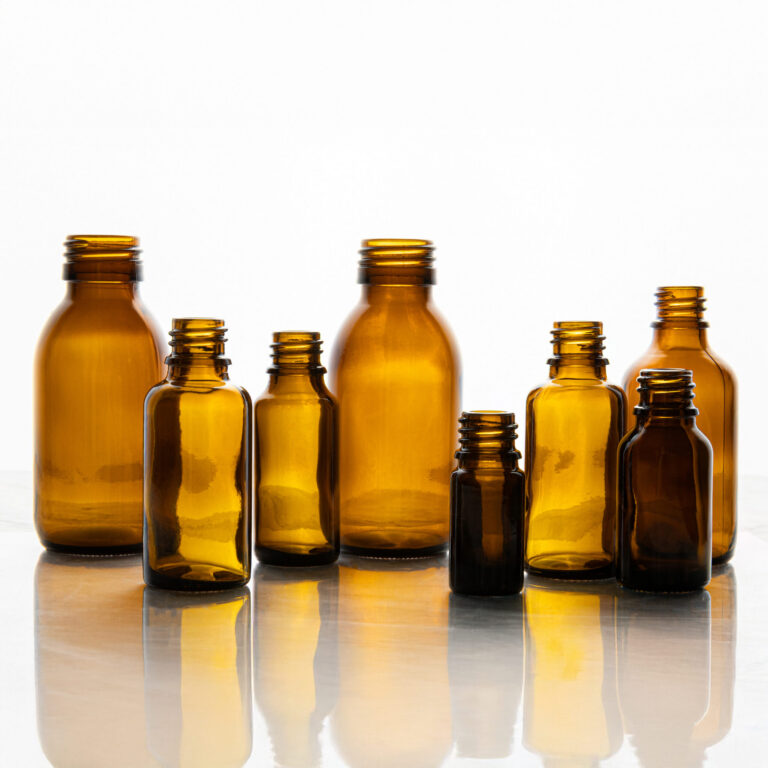
- It is worth packing photosensitive preparations in amber bottles with a tight-fitting closure,
- Household products often require a tamper-evident ring or a CRC.
It is not enough to simply select the cap. You need to check the entire system: the bottle, the thread, the dispenser, the insert, and the method of application.
Caps with dispensers and inserts – what is worth remembering?
The cap with a dispenser determines how the medication is administered. The sealing insert protects the contents against leakage and the influence of external factors. Both components must be matched to the bottle and the properties of the preparation.
For liquid medications, the tightness of the seal and dosing consistency are paramount. Drops require precision; syrups require convenient measuring; solutions require a secure closure. Therefore, the cap should be viewed as an integral part of the entire packaging system, rather than a separate accessory.
ABA Poland supplies pharmaceutical caps featuring dispensers, sealing liners, tamper-evident bands, and child-resistant (CRC) closures. The product range includes solutions for diameters of 18 mm and 22 mm, as well as for larger containers, designed to fit both glass and plastic bottles. Component selection is based on the type of formulation, the method of administration, and quality requirements.