
In this article, you will learn
- what should distinguish modern ones pharmaceutical bottles?
- When should you choose glass pharmaceutical bottles, and when plastic ones?
- How do you select the capacity, thread, and dispensing system for a specific product?
Pharmaceutical bottles as part of a packaging system
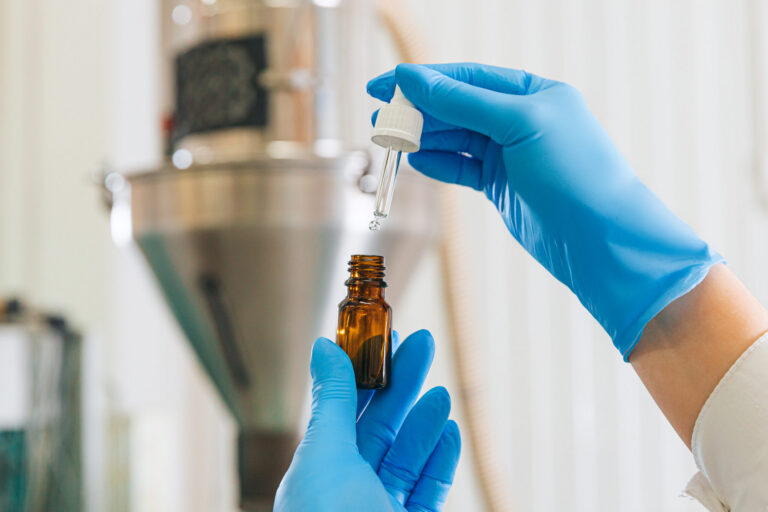
A modern medicine bottle does not function in isolation; it forms a system together with a cap and a sealing insert, as well as a dropper, pipette, atomizer, or measuring device. It is this complete assembly that ensures a tight seal and determines the method of administering the product.
Precision is key for drops, while convenient dosing is important for syrups. Solutions and tinctures require closures that minimize leakage and exposure to air; therefore, pharmaceutical bottles are selected based on both capacity and functionality.
Thread and closure compatibility for medicine bottles
The thread determines which type of closure can be used. The DIN 18 and DIN 28 standards are commonly found on pharmaceutical bottles. The smaller thread is typically used with droppers, pipettes, and small bottles, while the larger one is used for syrups, solutions, and larger-capacity containers.
An incorrectly selected thread carries the risk of leakage. A properly selected one allows the bottle, cap, and dispenser to be joined into a single, stable assembly.
Dosing and ease of use of pharmaceutical packaging
The bottle should facilitate the administration of the medication in accordance with its intended use. For liquid preparations, droppers, pipettes, flow restrictors, atomizers, dosing cups, or measuring devices are used.
This is important for pharmacies, manufacturers, and end-users. The product needs to be secure, yet easy to administer.
Glass pharmaceutical bottles – when are they the best choice?
Glass pharmaceutical bottles are used for preparations requiring chemical neutrality and effective protection of their composition. The glass does not react with the contents, alter the odor, or affect the properties of the medication.
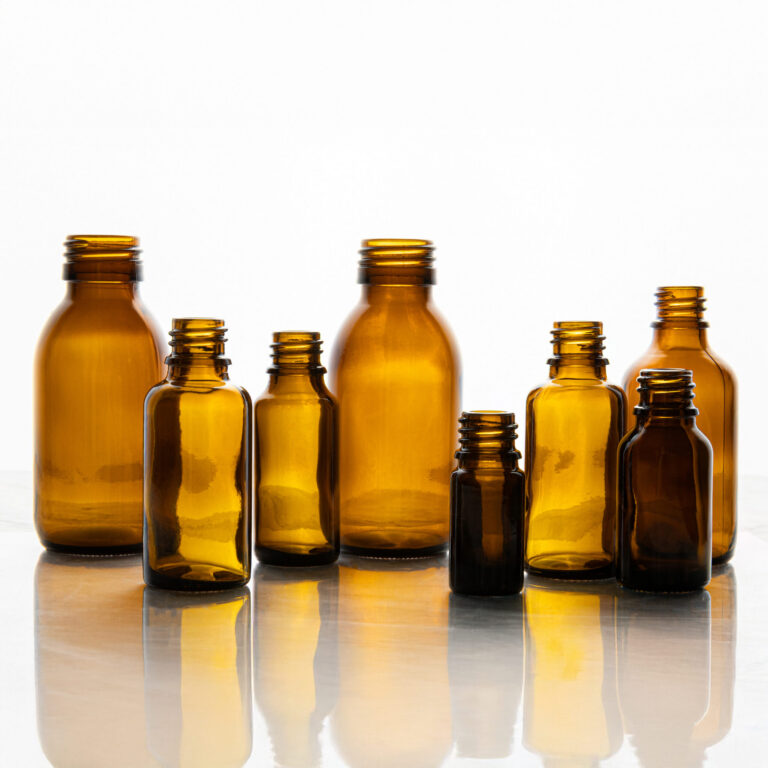
Clear or amber glass is most commonly used in pharmacy. Clear glass makes it easier to assess the appearance of the preparation. Amber glass limits light exposure, making it suitable for light-sensitive products.
Amber glass for light-sensitive products
Medicines, drops, tinctures, and certain solutions can lose their properties when exposed to UV radiation. Dark glass bottles are used in such cases; the amber color limits the amount of light reaching the contents of the container.
This solution is often chosen for compounded preparations, oils, liquid supplements, and products whose composition requires greater protection.
Clear glass for content inspection
Clear glass is suitable for applications where visual inspection is important. It facilitates the assessment of color, clarity, and any changes in the preparation.
Such bottles are used for products that do not require protection from light or are stored in an outer package.
Plastic bottles in the pharmaceutical industry
Plastic bottles are lightweight and resistant to mechanical damage. They perform well in transport and distribution, particularly in situations where glass would pose a higher risk of breakage.
In practice, they are used for syrups, supplements, liquid formulations, and products that need to be convenient for daily use. The material should always be selected based on the formulation's composition.
PET, HDPE, and PP in pharmaceutical packaging
Materials differ in terms of resistance, rigidity, and behavior in contact with the product. PET offers good clarity and low weight. HDPE is more mechanically resistant. PP is often used for closure components.
The choice of material should be based on the properties of the drug, the storage period, and transport requirements.
Plastic bottles for larger production runs
The material is well-suited for large-scale production, where factors such as packaging weight, damage resistance, and ease of logistics are key. Plastic bottles are also convenient for frequently used products, such as syrups or preparations for children.
Not every medication should be packaged in plastic. For sensitive products, glass may still be the better choice.
Capacities of apothecary bottles and their uses
Pharmaceutical bottles come in a variety of sizes. The capacity is selected based on the method of administration and the quantity of the preparation. Small bottles are used for drops, while larger ones are used for syrups, solutions, and liquid supplements.
Small pharmaceutical dropper bottles
Capacities of 5 ml, 10 ml, 15 ml, 20 ml, 30 ml, and 50 ml are used for drops, tinctures, concentrates, and preparations dosed in small quantities. In this category, the DIN 18 thread and compatibility with a dropper or pipette are important factors.
The small bottle minimizes the package volume and facilitates precise dispensing of the product.
Larger pharmaceutical bottles for syrups and solutions
Capacities of 100 ml, 150 ml, 200 ml, 250 ml, and 500 ml are used for syrups, suspensions, supplements, and solutions. In this category, the DIN 28 thread is more commonly used, along with caps featuring an insert, a tamper-evident ring, or a flow restrictor.
The larger bottle should be easy to pour from and work well with a measuring cup, jigger, or other dispenser.
Safety and labeling on pharmaceutical bottles
The medicinal product packaging must allow for the identification of the product. The name of the preparation, dosage, batch number, expiry date, and storage conditions are placed on the label or the surface of the packaging.
For liquid medications, closure components are also important. A tamper-evident ring indicates the initial opening. A child-resistant closure (CRC) system prevents accidental opening by children. A sealing insert minimizes the risk of leakage.
Tamper-evident ring
The ring detaches upon the first opening. The user can see whether the packaging has been tampered with. This is important in pharmacies, manufacturing, and distribution.
CRC and home safety
CRC (child-resistant closure) is used for products that should not be easily opened by children. The mechanism requires pressing down and turning the cap.
This solution works well for selected liquid preparations and supplements.
How do you choose the right pharmaceutical bottle for a medication?
Choosing a bottle starts with the product itself. Key factors include its composition, light sensitivity, viscosity, method of administration, and required volume.
- the drops require a small bottle, DIN 18 thread and a precise dispenser,
- It is best to pair the syrups with a larger bottle, a screw cap, and a measuring cup,
- It is worth packing photosensitive preparations in amber glass,
- Products exposed to transit may require a plastic bottle.,
- Medicines used at home often require a tamper-evident ring or a CRC (child-resistant closure).
There is no single bottle suitable for all formulations. The same material may work well for one product but prove unsuitable for another.
Pharmaceutical bottles – what is worth remembering?
Pharmaceutical bottles must protect the medication while also facilitating its administration. In modern packaging, it is not only the material that matters, but also the threading, closure, dispenser, and labeling.
Glass is suitable for formulations requiring neutrality and protection of the composition. Plastics are lightweight and resistant to damage. The choice should be based on the drug's form, storage conditions, and method of use.
Pharmaceutical bottle manufacturer – ABA Poland solutions
ABA Poland supplies pharmaceutical bottles and vials—including apothecary-style containers—suited to various forms of medication and compounded preparations. The product range includes both glass and plastic options compatible with screw caps, pipettes, droppers, atomizers, dosing cups, and measuring devices. Component selection is based on capacity, neck finish, dispensing method, and product quality requirements.