In this article, you will learn
- What are pharmacy jars used for in pharmacy practice and compounding?
- When should you choose a clear glass jar, and when a dark glass jar?
- How do you select the capacity, thread type, and closure for storing medications?
Apothecary jar – how does it differ from an ordinary jar?
A pharmaceutical jar is no ordinary storage container. It must be suitable for contact with the product, compatible with the closure method, and meet cleanliness requirements. In the pharmaceutical industry, consistency is key; every batch of packaging must meet the same specifications.
Glass used for pharmaceutical packaging should not react with the contents. It does not alter the preparation's odor or affect its composition. This is important for ointments, powders, capsules, tablets, and compounding ingredients.
Glass is well-suited for products requiring stable storage conditions. It does not absorb odors or stain as easily as some plastics. Consequently, glass pharmaceutical jars can be used for a wide range of preparations. In practice, this ensures greater control over the product; the packaging should not introduce additional risks to the composition of the medication or intermediate product.
Jars have a wider opening than standard bottles. This makes it easier to remove the contents, mix the preparation, and work with thicker formulations—factors that are particularly relevant for ointments, creams, pastes, and powdered substances. The wider opening also facilitates visual inspection, allowing a pharmacist or production worker to more quickly assess the appearance of the preparation and the condition of the packaging.
Uses of apothecary jars
Pharmacy jars are used in several areas. They differ in terms of the type of contents, the method of dispensing, and the requirements for protection against external factors.
Jars for ointments, creams, and pastes
Semi-solid preparations require packaging that allows for the convenient dispensing of the contents. A jar is more suitable than a narrow-necked bottle because it provides access to the entire volume of the product. This is important for compounded ointments, pharmacy-prepared creams, and pastes.
For this group, a tight seal is important. The lid or cap must limit the product's contact with air and protect the contents during transport.
Jars for tablets, capsules, and supplements
Tablets and capsules require protection against moisture, contamination, and mechanical damage. Glass jars are suitable for packaging larger numbers of doses. They are also well-suited for dietary supplements.
In such applications, the cap is important. It may feature a sealing insert, a tamper-evident ring, or a child-resistant mechanism.
Jars for powders and granules
Powders and granules require a dry, airtight environment. The packaging should limit moisture exposure and facilitate portioning. A jar offers convenient access to the contents and allows for the use of accessories such as a measuring scoop or spoon.
For free-flowing substances, the shape of the packaging is also important. A stable base facilitates work at the compounding station or in the warehouse.
Dark glass jars and protection from light
Not every preparation can be stored in clear glass. Some substances are light-sensitive. In such cases, brown or amber glass is used.
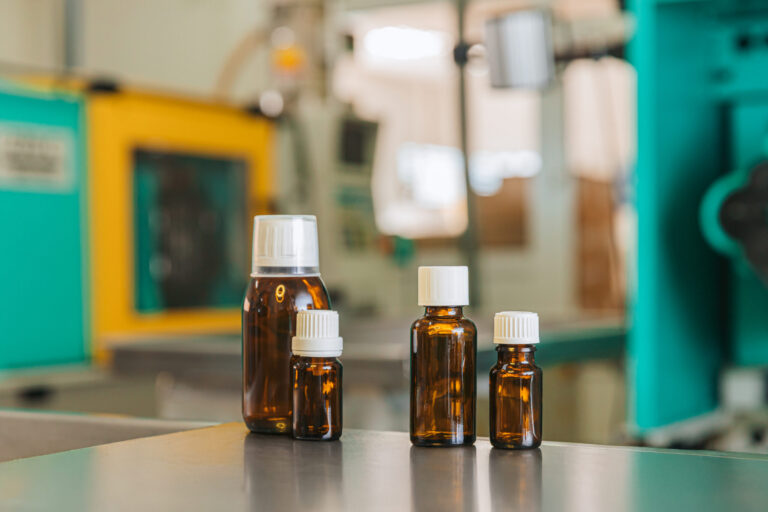
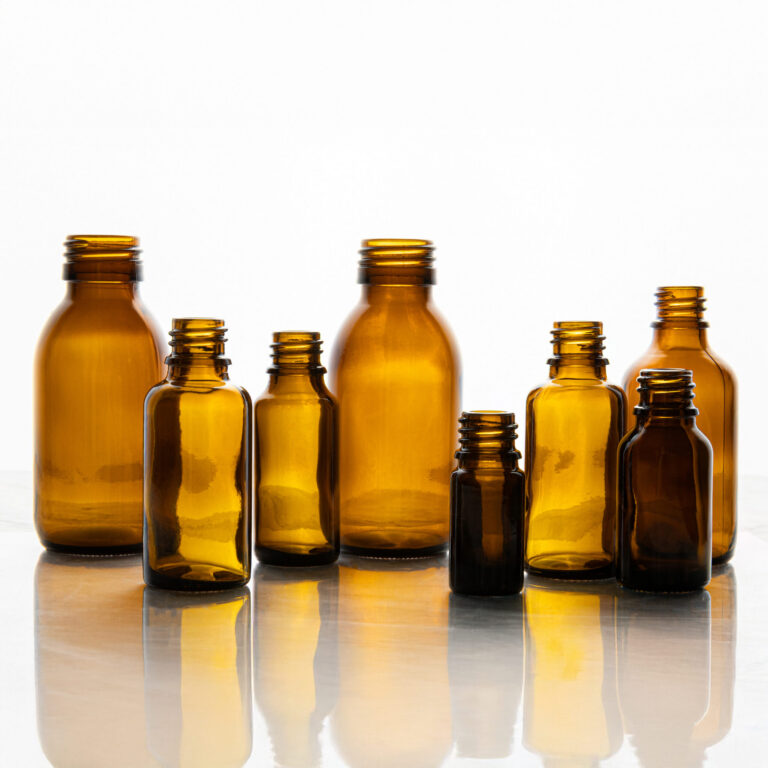
Dark glass apothecary jar
A dark glass apothecary jar limits UV radiation from reaching the contents of the container. This is important for light-sensitive substances, certain supplements, herbal preparations, and compounded products.
Dark glass does not replace proper storage conditions, but it helps limit the impact of light. This is particularly important for sensitive preparations.
Clear jars for content inspection
Clear glass is suitable for applications requiring quick visual inspection of the contents. It facilitates the assessment of color, consistency, and any changes in the formulation. It is used for products that do not require protection from light.
The choice between clear and brown glass should be based on the product's properties, not merely on the appearance of the packaging.
Capacities and threads of apothecary jars
The choice of capacity depends on the quantity of the product and its intended use. Small jars are suitable for formulations and samples, while larger sizes are used for production, supplements, and the storage of larger batches.
Small pharmacy jars for compounding
Capacities of 30 ml, 40 ml, 60 ml, and 75 ml are used for ointments, creams, and small quantities of a preparation. Such containers are convenient for extemporaneous compounding and short production runs.
A small jar limits the volume of air above the product and facilitates its rapid use.
Medium and large pharmaceutical jars
Capacities of 100 ml, 120 ml, 150 ml, 200 ml, and 250 ml are used for capsules, tablets, supplements, and larger portions of semi-solid preparations. A larger jar facilitates packaging and storage.
For larger capacities, the quality of the closure is of greater importance. The thread must be compatible with the cap and the sealing insert.
Thread and nut on a glass jar
Pharmaceutical jars are compatible with various thread standards. Common designations include 33/400, 38/400, and 45/400. This notation helps in selecting the right cap for the container's neck.
An improperly selected cap can cause leaks. A well-chosen one creates a stable system: the jar, thread, liner, and closure work together.
Storing medicines in glass jars
The storage of medicines and raw materials requires environmental control. Factors such as temperature, humidity, light exposure, and protection against accidental opening are crucial. Packaging is one element of this process.
Moisture can alter the properties of tablets, capsules, powders, and granules. Therefore, pharmaceutical jars should be tightly sealed. Sealing liners help limit the entry of air and moisture into the packaging.
Checking the label is also important for long-term storage. The packaging should have space for the product name, preparation date, batch number, and expiration date.
Closures with tamper-evident rings are frequently used for pharmaceutical products. This allows the user to see whether the packaging has been previously tampered with. CRC closures are also used for certain preparations.
Such solutions are significant in pharmacies, manufacturing, and distribution. They protect the contents and facilitate control over product circulation.
Apothecary jar – what is worth remembering?
Choosing a jar begins with the contents. Factors such as the form of the product, its sensitivity to light, the required seal integrity, and the method of dispensing are all important.
- ointments and creams require a wide infusion and convenient access to the contents,
- tablets and capsules require protection against moisture and a well-fitting cap,
- powders and granulates need a dry and airtight environment,
- It is worth packing photosensitive preparations in brown or amber glass,
- Larger batches require a capacity tailored to the warehousing and distribution process.
There is no single jar suitable for all medications. The packaging should be determined by the properties of the preparation and the method of its use.
ABA Poland Solutions
ABA Poland supplies pharmaceutical and pharmacy jars suitable for storing solid and semi-solid preparations, as well as selected compounded products. The product range includes glass jars and plastic containers compatible with various caps and sealing liners. Packaging selection is based on the form of the preparation, required seal integrity, and storage conditions.